By Melanie Steen
“I always say what I’m getting out if it is seeing my vision continue to become a reality,” says Jackie Joyner-Kersee.
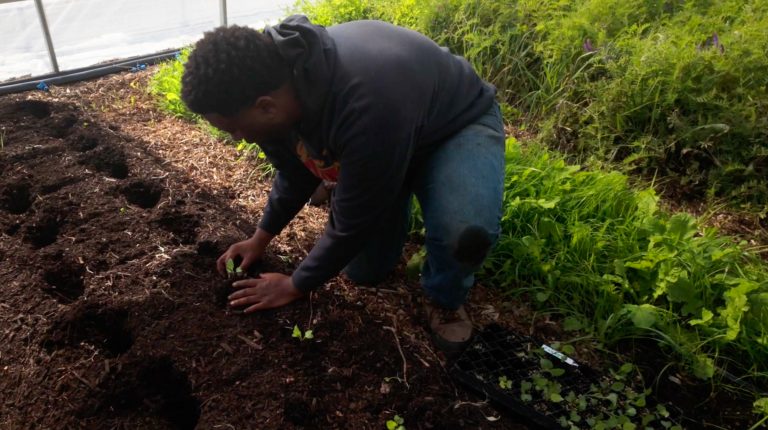
Olympian Jackie Joyner-Kersee has been giving back to the East St. Louis community for 25 years now through her JJK Foundation. More recently, she’s expanded her reach by developing JJK FAN. The “FAN” is an acronym for food, agriculture and nutrition innovation center. Its purpose is to show local kids and teens how they can grow their minds, while also growing healthy food.
“Young people plant seeds, and being able to nourish the seeds, watering and to see them blossom and see, wow, this is what comes out,” says Joyner-Kersee. “And that’s what we want to do with our students. They plant those seeds, introduce them to a space that they don’t often hear about, or don’t even connect. They don’t realize that agriculture is in everything we do.”
JJK FAN is a collaborative effort between the JJK Foundation, the Donald Danforth Plant Science Center, the U of I Extension, and Lansdowne UP.
“People look at it and say okay, what’s going on here, what’s Jackie doing now,” says Kevin Green, Director of Administration with Lansdowne UP. “And with Lansdowne UP, we have become known within the community as that arm that’s actually cleaning up the community, cleaning up the lots and trying to beautify everything here in the environment.”
At the heart of the program is having food access. According to JJK FAN, many kids and their families in East St. Louis must travel to other communities for healthy food.
“We’re living in a world where fruits and vegetables cost more than a bag of chips,” says JJK FAN alum, Jordon Gully. “Healthy foods are harder to access. Not only because of its availability in our community, but also because of its price.”
“They all want to run fast, they all want to jump far,” says Joyner-Kersee. “And I tell them, I had to eat right. I had to make sure I was putting the right nutrients in my body.”
“I just knew it was more corner stores than grocery stores, that’s what I could always see,” says JJK FAN alum, Zhakeya Hawkins. “Like, we would have to drive so far to get actual groceries.”
Zhakeya Hawkins is a 20-year-old sophomore at Kentucky State University. She’s got something in common with Jackie – she ran track while attending East St. Louis High School. She’s now the captain of her college track team. KhakeYa credits the program with teaching her how to fuel her body with healthy food. The internship also exposed her to careers in S.T.E.M. In fact, while she was at the Danforth Plant Science Center, Dr. Parag Bhatt, a Data Scientist Trainer introduced her to Storymaps and its importance in telling the story of food insecurity.
“He says, get the computers and laptops out,” says Hawkins. “We opened up Storymaps and we were writing about food insecurity in the East St. Louis area. And out of nowhere, he showed us how to do it, what to do. And I said so, you play with numbers all day, and you just make numbers make sense? So you extract knowledge from numbers and what they mean by visualizing it? And I was like, oh, this is what I want to do.”
Hawkins is now majoring in computer science, with an emphasis in mathematics. Her goal is to obtain her PhD and then pursue a career as a data scientist. She’s in college, not on an athletic scholarship, but on an academic one.
“High school age students, East St. Louis residents – so, a lot of them come from the high school,” says Kurly Taylor, Strategic Partnership Manager with the Donald Danforth Plant Science Center. “And essentially, we give them a crash course over eight to nine weeks on plant field research, but also a controlled environment research. But also,we give them soft skills training, so prepare them with financial literacy. And then field trips. We work with a lot of Ag organizations and industries in that area for them to get exposed to career pathways, professionals in that space.”
To date, about ten students have gone through the JJK FAN program, including 18-year-old Jordon Gully.
“That’s one thing that Jackie always says, there’s gold in all of us,” says Gully. “And she always invests in that community.”
Gully has been involved with these programs since he was six-years-old. He’s thankful to Kersee for seeing the gold in him, and so many others like him.
“Being from East St. Louis, the expectation is that I’m not supposed to be in the spaces that I’ve been in,” he says.“But, because of the JJK Foundation and the FAN, I’ve been able to go into spaces that usually, not too many people who look like me are in.”
Gully is currently attending the University of Illinois – Urbana Champaign on a full scholarship, majoring in public policy and law, with a minor in political and civic leadership.
“We do engage with interns from U of I, the Champaign-Urbana campus, Lincoln, and surrounding colleges,” says Laquitsha Bejoile-Hayes, Extension Outreach Associate with the College of Aces at U of I Extension. “They’re all able to, if they have graduate assistants, capstones that graduate students have to complete, internships – we use those. If they’re aligned to what our mission is and what we’re trying to accomplish, we make sure that we’re able to give those kids opportunities.”
Even though Kersee is fully immersed in helping children and young adults in her hometown, she tells us she still finds time to mentor young Olympic athletes.
“I don’t ever forget that everything that I’ve been able to do is because of my connection to sports, and how I was able to use sports for good,” says Joyner-Kersee. “And be able to shine a light on a community that sometimes, the light is dim. It’s my hope that this will outlive me. In order for us to keep evolving, we’ve talked about building an endowment. And also to also see some of our students who’ve come through the program come back and teach what they’ve learned.”
While Kersee is not slowing down anytime soon, I asked her what she would want her future legacy to be.
“What I would want people to say is that she was a great human being,” she says. “A connector, in trying to make a difference in the community of East St. Louis first, but nationally and worldwide.”